Fire extinguisher types and agents, explained
Reviewed July 2026
The agent inside a portable extinguisher does two jobs: it decides what fires the unit fights, and it decides the maintenance schedule the unit runs on. Here is the field guide.
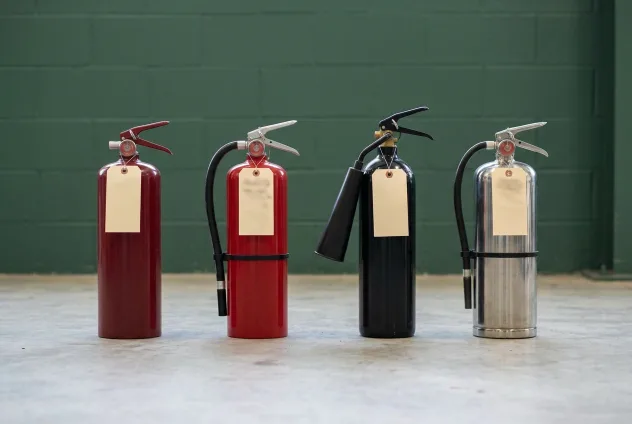
Dry chemical (ABC, BC, Purple-K)
The workhorses. ABC (multipurpose) covers ordinary combustibles, flammable liquids, and energized equipment; BC (sodium bicarbonate) and Purple-K are tuned for flammable-liquid and hazard use. Stored-pressure dry-chemical units run a 6-year internal exam and a 12-year hydrostatic test.
CO2
Carbon dioxide, for flammable liquids and energized equipment, leaves no residue. CO2 extinguishers run a 5-year hydrostatic test, with the internal exam commonly performed together with it as one service event.
Water and water-based
Plain water and water-mist units, for ordinary combustibles only. They run a 5-year hydrostatic test. Loaded-stream and antifreeze variants take an annual internal exam, which is an easy trap when a "water" unit is really a loaded-stream one.
Wet chemical (Class K)
The kitchen extinguisher, for cooking oils and fats, paired with the hood system over the line. Wet-chemical units run on a 5-year clock for their shell test.
Clean agent and halon
Clean-agent extinguishers (such as Halotron) and legacy halon units protect sensitive electronics and equipment. Both run a 6-year internal and a 12-year hydrostatic test. Halon is legacy — the agent is recovered, not vented, at service.
Foam (AFFF / FFFP)
Film-forming foam units have their premixed agent replaced on a 3-year cycle, which serves as the internal service, and run a 5-year hydrostatic test. Production of these agents has ended at major makers, so plan replacements ahead.
Why the agent drives the schedule
Because each agent carries its own internal and hydrostatic clock, a building's extinguishers rarely share one due date. Recording the agent accurately is what makes the schedule right.
Cadences vary by jurisdiction — verify with your AHJ.
Frequently Asked Questions
- Why does the agent type matter for scheduling?
- Each agent carries its own internal and hydrostatic interval. Dry-chemical, clean-agent, and halon units run a 6-year internal and 12-year hydro; water, CO2, and wet-chemical units are hydro-tested every 5 years; foam replaces its agent every 3 years.
- What class of extinguisher goes over a commercial cooking line?
- A wet-chemical (Class K) extinguisher, for cooking oils and fats, paired with the hood suppression system. It runs on a 5-year hydrostatic clock under NFPA 10.
Cadences vary by jurisdiction — verify with your AHJ.
Run the whole route in one place
GaugeRoute keeps every asset on its NFPA-keyed schedule, the inspection on the record, and the billing on your own rails. Free to start.