The service van, test bench, and gear you actually need
Strip this trade down to its tools and it is short: a vehicle set up to carry cylinders and agent, an accurate way to weigh and pressurize, a supply of tags and seals to close out each job, and hand tools to service a valve. Everything else is scale. This chapter is the practical gear list, sorted by what you buy first, what you can defer, and what rides on the truck for a route day.
The theme throughout is buy accuracy and buy safety, defer capacity. You want calibrated measuring tools and secure storage from day one. You can add a hydrostatic test bench and a bigger van later, out of revenue. Dollar figures here are labelled ranges or attributed to a source; verify current vendor pricing when you buy.
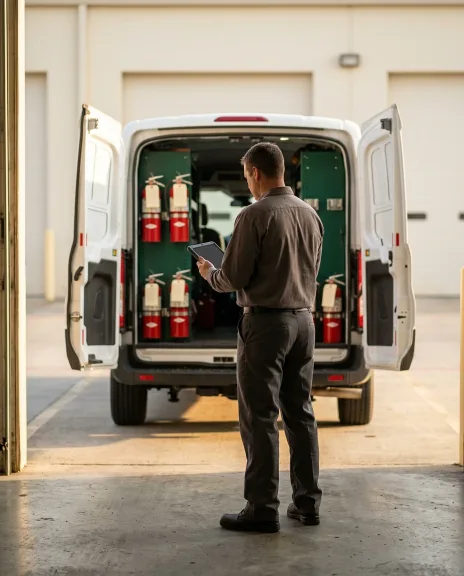
The vehicle, and how to outfit it
A used cargo van is the standard service vehicle, and a reliable one is commonly budgeted at $15,000 to $30,000 (per withessential.com, 2026). New work vans cost far more for reference: 2026 MSRPs start around $44,595 for a Chevrolet Express 2500 and above $53,000 for a Ford Transit-250 (per Chevrolet.com and cars.com, 2026), which is exactly why most one-van shops start used. If you already own a suitable vehicle, start with it and buy the dedicated van later.
Outfitting matters more than the badge. Put in shelving or a rack so cylinders stand secured and do not roll, a mounted or strapped position for your nitrogen cylinder, and a bin system for tags, seals, O-rings, and small valve parts so you are not digging on a customer site. Cargo of compressed gas and agent has handling and, in some places, placarding rules, so confirm what applies to your vehicle and load with your authority.
Carry a few loaner extinguishers too. When you pull a customer unit for recharge or send a cylinder out for hydro, a loaner keeps their bracket covered while the work is done, and it is a small inventory cost that saves you a second trip.
The recharge station: buy this early
Recharge gear is affordable and you use it constantly, so it is a day-one buy. At its simplest it is a nitrogen cylinder and regulator, a dry-chemical fill setup, the right recharge adapters, and a calibrated scale. Trade distributors sell dry-chemical refill kits as a single package with the funnels, regulator, scoop, adapter kit, nitrogen hose, and tape, which is a sensible starting point for a new shop before you build out a dedicated fill station.
As volume grows you can step up to a powder-handling and recharge system built for shop or mobile-truck use, which speeds up dry-chemical work and cuts mess. That is a reinvestment, not a launch purchase. Start with the kit, get fast with it, and upgrade when the route justifies it.
The hydro test bench: usually buy later
Hydrostatic testing is the one capital-heavy station most new shops defer. A proper setup means a water-jacket or direct-expansion test rig plus the pressure gear to run it, and there is a legal gate on top of the money: under U.S. DOT rules you can only requalify fire extinguisher cylinders if your company holds a Requalification Identification Number (RIN), and each passing cylinder is marked and the result recorded per federal rule (per eCFR 49 CFR 180.209 and 180.213).
The cadence is what makes deferring sensible. Common DOT 4B, 4BA, and 4BW cylinders up to 12 pounds water capacity requalify every 12 years (per eCFR 49 CFR 180.209), so a new route does not generate enough hydro volume to keep a bench busy. Sending cylinders to an established shop that already holds the RIN is cheaper than owning idle equipment until your volume grows. The recharge-and-hydro chapter walks the buy-versus-sub decision and the crossover point.
Calibrated gauges and scales: your real product
Accuracy is what a customer is actually paying for, so the measuring tools are non-negotiable and they get calibrated on a schedule. You need an accurate scale to confirm agent weight, especially on CO2 units where weight is how you verify the charge, and to hit target fill weights on recharges. You need accurate pressure gauges for reading and setting stored-pressure units.
Build a small recurring line into your budget for recalibration against a known standard, because gauges and scales drift over time. A tool that reads wrong is worse than no tool: it puts your stamp on a bad number. Track each instrument on its own recalibration due date the same way you track a cylinder on its NFPA due date.
Tags, seals, verification collars, and labels
These consumables are how you close out a job and leave proof behind. Every serviced unit gets a dated service tag, a fresh tamper seal on the pull pin, and, after certain internal service, a verification collar under the valve. You buy these in bulk and restock constantly, so treat them as a float you refill from revenue rather than a one-time purchase.
The tag is the visible record on the unit, and what belongs on it is specific: the service date, the work performed, and your technician and license identification, following the standard and your jurisdiction. Our service-tag guide covers exactly what each tag and collar has to show. For your own printed labels, the label template tool gives you a clean, correctly sized starting layout instead of eyeballing one.
Hand tools and shop consumables
The hand-tool side is ordinary and inexpensive: valve wrenches and spanner tools for opening cylinders, a vice or fixture to hold a unit while you work, O-ring picks, hose and nozzle service tools, and a good set of the basics. Keep a stock of the wear parts you replace most, O-rings, valve stems, hoses, nozzles, and gauges, so a common repair does not turn into an ordered part and a return trip.
Round it out with the shop safety gear you would expect around compressed gas and dry chemical: eye protection, gloves, and proper ventilation when you handle agent. None of this is a big number, but a $3 O-ring you failed to pack costs you far more than the part on a customer site.
Where to buy: vendor categories, not brand hype
You will buy from a few kinds of supplier, and it helps to know the categories rather than chase one name. Trade equipment distributors carry recharge kits, adapters, valves, tags, seals, and the small parts you reorder; several are members of the National Association of Fire Equipment Distributors (NAFED), which is the trade body for this supply channel. Specialist equipment makers build the recharge and hydro-test machinery you graduate into. Agent and cylinder suppliers handle bulk dry chemical, CO2, wet chemical, and nitrogen.
Compare on total landed cost, restock speed, and whether a supplier can support the equipment they sell, not on marketing claims. Get pricing in writing from more than one distributor before you commit, because on recurring consumables a small per-unit difference adds up across a year of route work.
The route-day kit: what rides on the truck
A route day is different from a shop day, and the truck should be packed for it. Carry your calibrated gauges and a scale, a nitrogen cylinder and recharge adapters for on-site top-offs, a full stock of tags, seals, and collars, common valve parts and O-rings, hoses and nozzles, your hand tools, and a few loaner extinguishers. Add your inspection paperwork or the device you record on, plus signage and personal safety gear.
The habit that keeps a route day profitable is not a tool at all: it is knowing exactly which units are due at each stop before you drive, so you carry the right parts and never make a wasted trip. Route software that keeps every asset on its NFPA clock and builds the stop list for you turns a scattered day into a tight one. The building-a-route guide covers how to sequence stops so the cadence works for you instead of against you.
Go deeper
Frequently Asked Questions
- What equipment do I need to start a fire extinguisher service business?
- At minimum: a vehicle set up to carry cylinders and agent safely, a recharge setup (nitrogen regulator, dry-chemical fill kit, adapters), a calibrated scale and accurate pressure gauges, a stock of tags, seals, and verification collars, and hand tools for valve and hose service. A hydrostatic test bench is optional at first because most new shops sub hydro testing out until their volume grows.
- Do I need a new van, or will a used one do?
- A reliable used cargo van is the standard first vehicle and is commonly budgeted at $15,000 to $30,000 (per withessential.com, 2026), well below new work-van MSRPs that start above $44,000 (per Chevrolet.com and cars.com, 2026). If you already own a vehicle that can carry a rack of cylinders and a small stock of agent safely, start with it and buy the dedicated van later out of revenue.
- Should I buy a hydrostatic test bench or send cylinders out?
- Send them out at first. Hydro testing needs a capital-heavy rig and a DOT Requalification Identification Number (RIN) to be legal (per eCFR 49 CFR 180.209 and 180.213), and the 12-year cadence on common cylinders means a new route will not keep a bench busy. Sub the work to a shop that already holds the RIN, and buy the bench once your volume justifies it.
- Where do fire extinguisher shops buy their supplies?
- From trade equipment distributors (many are members of the National Association of Fire Equipment Distributors, NAFED) for recharge kits, tags, seals, valves, and parts; from specialist equipment makers for recharge and hydro machinery; and from agent and gas suppliers for bulk dry chemical, CO2, wet chemical, and nitrogen. Compare on landed cost, restock speed, and support, and get written quotes from more than one before committing.
- What has to be on the service tag I leave behind?
- The tag records the service date, the work performed, and your technician and license identification, following the applicable standard and your jurisdiction. Certain internal service also calls for a verification collar under the valve. The service-tag guide breaks down exactly what each tag and collar must show; because details vary by jurisdiction, verify the specifics with your AHJ.
Run the whole route in one place
GaugeRoute keeps every asset on its NFPA-keyed schedule, the inspection on the record, and the billing on your own rails — with unlimited technician seats. Free to start.