Recharge and hydrostatic testing as a revenue line
The annual tag gets you in the door. The money past it is in the work the tag turns up: the units that need a recharge, the shells coming due for a hydrostatic test, the deficiencies you find on the walk. Every one of those is a separate line at a higher price than the inspection.
This chapter is about that revenue and what it costs you to earn it. The mechanics of when a unit gets recharged or tested live in the cadence guides. Here we look at the economics: what these lines are worth, what equipment and federal rules stand behind them, and whether to do the work yourself or hand it to a partner shop.
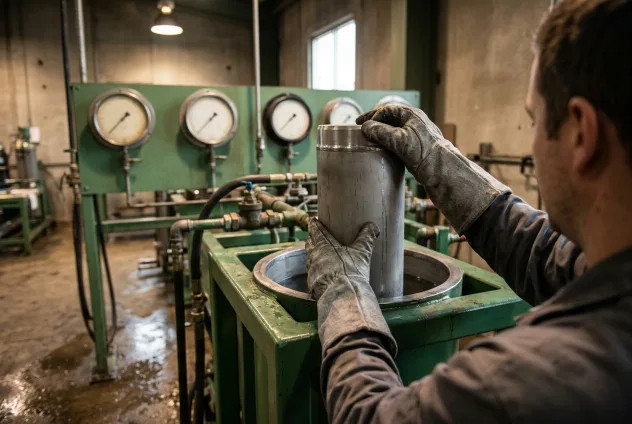
Recharge is the everyday add-on
Recharge is the most common paid work a route turns up. A unit that has been used, has drifted below charge, or is due for its internal service needs the agent refilled and the unit repressurized and tagged. You find these on the annual walk, quote them, and often do them the same day.
The per-job numbers are modest but they stack. A recharge on common dry-chemical portables commonly runs a range of roughly $25 to $50, with smaller units at the low end (per FireTron and 119 Fire Control service-cost guides, 2025). CO2 and Class K units cost more to recharge because the agent and handling are specialized, sometimes into the hundreds on larger cylinders (per Ironclad Fire Protection, 2025).
The margin is real because you are already on site with the truck stocked. The drive is paid for by the inspection; the recharge is incremental work at incremental cost. A route that reliably finds and quotes recharges earns well above the tag revenue alone.
Recharge or replace, from the shop side
Not every discharged or overdue unit is worth recharging, and the honest call protects the customer and your reputation both. The comparison is not recharge price against a new unit alone. It is the recharge plus the cost of the next internal exam and hydrostatic test, measured against a new unit that resets both clocks.
On an old shell facing a near-term hydrostatic test, replacement often comes out ahead, and a non-rechargeable (disposable) unit is always replaced, never serviced. Knowing where that break-even sits, per agent and per shell age, is what lets you quote the right remedy instead of the reflexive one.
Either way, the finding becomes a documented line item: recharge, internal, hydrostatic, or replacement, each priced by you, each shown to the customer for what it is. The recharge-vs-replace guide walks the decision unit by unit.
Hydrostatic testing: in-house or subbed out
Hydrostatic testing is the longest-cycle, highest-ticket service on the extinguisher, and it is the one with a federal wall around it. Per-unit hydrostatic pricing commonly runs a range of roughly $20 to $50 for standard dry-chemical units and higher for CO2 and larger cylinders, often quoted with the required recharge bundled in, which pushes typical 5-to-10-pound jobs into the $75 to $115 range and wheeled units well past that (per Kord Fire Protection and Ironclad Fire Protection, 2025).
The catch is who is allowed to do it. Hydrostatic testing of DOT-specification cylinders — CO2 and other high-pressure units — is regulated under 49 CFR Part 180, and only a facility holding a Requalification Identification Number (RIN) from PHMSA may requalify them (per PHMSA, U.S. DOT, 2025). Getting a RIN means arranging an onsite inspection by an authorized independent inspection agency and running test equipment accurate to within one percent with a calibrated gauge and calibration cylinder; a RIN is valid for five years before renewal (per PHMSA / eCFR 49 CFR 180.205 and 180.209, 2025).
That is real overhead. Many new shops sub the hydrostatic work to a partner testing house, mark it up as a coordinated line on their own invoice, and keep the customer relationship while someone else owns the test bay and the certification. Bringing it in-house pays off once the volume justifies the equipment and the RIN, not before.
The capital and stock behind the work
Recharge you can bring in-house for far less than hydro. The core is a recharge and repressurizing setup — a nitrogen fill station and the right recharge adapters for the units you service. Individual recharge and pressurizing adapters are inexpensive, commonly a range of roughly $9 to $275 apiece depending on the fitting (per Hydro-Test Products, 2025); the larger cost is the nitrogen supply, the scales, and the agent stock.
Then you carry consumables: dry-chemical agent in bulk, wet-chemical and CO2 for the units you handle, replacement O-rings and seals, tamper seals, verification collars, and dated tags. Cartridge-operated units need spare cartridges on the shelf. The stock you carry is set by the service menu you chose, so decide the menu first and buy to it.
Whole-business startup figures for a fire-extinguisher service company commonly land in a range of roughly $40,000 to $100,000 depending on scale, vehicle, and how much testing you bring in-house (per a 2025 fire-extinguisher business startup guide, serif.ai). The recharge and hydro capability is a large share of the spread between the low and high end of that range.
Pricing the add-on lines
Quote each scope on its own line so the customer sees what they are paying for and why. The annual maintenance and tag is the base; the recharge, the internal exam, the hydrostatic test, and any replacement are separate remedies at separate prices. Bundling them into one opaque number is how shops both undercharge and lose trust.
Because these lines only appear when the walk turns them up, the revenue is uneven per visit but predictable across a book. Over a route, a knowable fraction of units come due for internal and hydrostatic work each year, and a knowable fraction turn up needing recharge. That mix is what makes the add-on lines a forecastable revenue stream, not a windfall.
Guard the trust that revenue rides on. A shop that quotes a recharge on a unit that plainly needs replacing, or bundles a hydrostatic test the customer did not need this year, wins one invoice and loses the account. The higher-ticket lines are worth the most when the customer believes every one of them was the honest call. Price them fairly, quote only what the unit’s life actually calls for, and the add-on work becomes a reason accounts stay with you rather than shop around.
Requirements vary by jurisdiction, so verify the intervals and the acceptance criteria with your AHJ before you quote the higher-tier work. You and the authority certify the service; your price and your line items are yours to set.
Recording the extra work against the serial
The add-on revenue only compounds if you can see it coming. An internal exam six years out and a hydrostatic test twelve years out are booked the day you record the unit, but only if the record anchors them to the serial and the manufacture date and generates the due dates for you.
A per-serial record that carries each unit’s agent, shell age, and last service is what turns the recharge and hydro work from a surprise into a scheduled line you already own. It also holds the dated proof of what you did, so the higher-ticket work is defensible later. The record is the reminder and the receipt; you and the AHJ remain the ones who certify.
Go deeper
Frequently Asked Questions
- How much can a shop charge for recharge and hydrostatic testing?
- Recharge on common dry-chemical portables commonly runs a range of roughly $25 to $50, and higher for CO2 and Class K units. Hydrostatic testing commonly runs roughly $20 to $50 for standard dry-chemical shells and $75 to $115 or more for 5-to-10-pound units when the required recharge is bundled in (per FireTron, Ironclad, and Kord Fire Protection service-cost guides, 2025). Both are higher-margin than the annual tag because you are already on site.
- Do I need a special license to do hydrostatic testing in-house?
- To hydrostatically test DOT-specification cylinders such as CO2 units, yes: the work is regulated under 49 CFR Part 180 and requires a Requalification Identification Number (RIN) from PHMSA, an onsite inspection by an authorized agency, and calibrated test equipment (per PHMSA, U.S. DOT, 2025). A RIN is valid for five years. Many shops sub this work to a partner testing house until volume justifies the setup.
- Should I bring hydro testing in-house or sub it out?
- Sub it out at first. The RIN, the test bay, and the equipment are real overhead that only pays off at volume. Marking up a partner house’s hydrostatic work as a coordinated line on your own invoice keeps the customer relationship without the capital, and you can bring it in-house later when the numbers support it.
- What stock do I need to offer recharge?
- A nitrogen fill and repressurizing setup with the right recharge adapters, plus dry-chemical agent in bulk, the specialty agents for any CO2 or Class K work you take, replacement O-rings, seals, tamper seals, verification collars, dated tags, and spare cartridges for cartridge-operated units. The stock follows the service menu you chose, so set the menu first.
- How do I decide recharge versus replace on price?
- Compare the recharge plus the cost of the next internal exam and hydrostatic test against a new unit that resets both clocks. On an old shell facing a near-term hydrostatic test, replacement often wins, and a non-rechargeable unit is always replaced. Quote the remedy that is honestly cheaper over the unit’s remaining life.
Run the whole route in one place
GaugeRoute keeps every asset on its NFPA-keyed schedule, the inspection on the record, and the billing on your own rails — with unlimited technician seats. Free to start.