NFPA 10 basics for a new inspection business
Before you price a single site, you need to know the clocks the work runs on. NFPA 10 is the standard behind portable fire extinguishers, and it does not describe one job. It describes several, each on its own interval, each a separate thing you can put on an invoice.
This chapter is the map, not the manual. It walks the cadence at the level a business owner needs to decide what to offer and how the year fills up. When you want the itemized mechanics of any one job, the cadence guides go deep on each. Here we stay on the business.
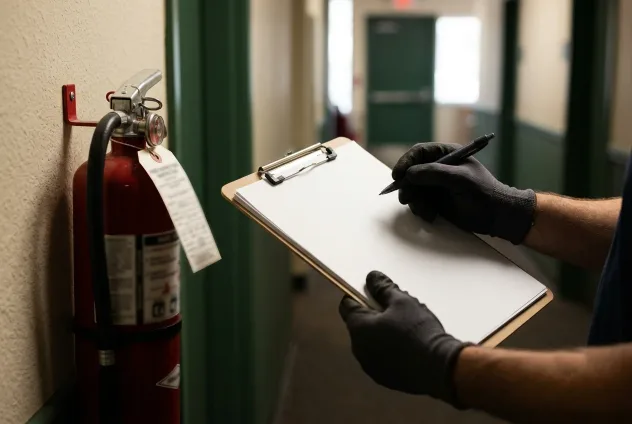
The four jobs on every extinguisher
Under NFPA 10, a single portable extinguisher is not on one schedule. It is on four, and they nest inside each other.
The first is the owner monthly visual check. Between your visits, the building’s own staff give each unit a quick look: is it in place, is the gauge in the green, are the pin and seal intact, is anything blocking it. That one is the customer’s job, not yours, though you often coach them on it and leave them a sheet to log it.
The second is the annual maintenance, and this is your bread and butter. Once a year, a licensed technician runs a full external check of each unit and puts a fresh dated tag on it. Every extinguisher gets this, whatever the agent inside. It is the visit that anchors the whole route.
The third is the 6-year internal examination. Most stored-pressure dry-chemical units get opened up, emptied, inspected inside, resealed, and recharged every six years. Some agents run their own internal clock, so this one is keyed to the agent, not a blanket rule.
The fourth is the hydrostatic test on the shell itself, the longest cycle of all. Dry-chemical, clean-agent, and halon units are tested every 12 years; water, CO2, and wet-chemical (Class K) units every 5 years.
Four jobs, four clocks, one bottle. That structure is the whole reason this trade recurs.
Two more clocks beyond the extinguisher
Most shops do not stop at extinguishers, because the same customers own two more assets that run on their own schedules.
Commercial kitchen hood suppression systems — the wet-chemical systems over a cooking line — are serviced semi-annually under NFPA 96 and UL-300. Every six months, twice the frequency of the annual extinguisher tag. A restaurant on your book is at least two visits a year before you count anything else.
Emergency and exit lighting is tested under NFPA 101 on two clocks: a brief monthly function test that usually falls to the building owner, and a full-duration annual test, commonly 90 minutes on battery alone, that becomes a professional dated record. That annual test is a natural add-on to a site you are already standing in.
Neither of these is NFPA 10 work, but both land on the same customers on the same route. Deciding whether to offer them is one of the first service-menu calls you make.
The cadence is the recurring revenue
Here is the part that matters for a business owner: none of these clocks is optional and none of them is a one-time sale. A site you tag this July is due again next July. A kitchen you service in spring is due again in fall. A dry-chem unit you sell today books its own internal exam six years out and its hydrostatic test twelve years out, on your calendar, in your record.
That is not a schedule you have to sell against every year. It is a renewal book that fills itself, as long as you can see what is due and get back to it. The cadence is the product. Your job is to hold the accounts and never lose a due date.
It is also why a service menu is worth thinking through before your first account. Every job you learn to offer is another line on the same visit and another clock ticking toward a return.
Which of these you actually offer
You do not have to do all of it on day one. Shops commonly start with the annual maintenance and tag, which needs the least equipment, then add the internal and hydrostatic work as the book grows.
The annual tag itself is a modest per-unit charge. Commercial per-unit inspection-and-tag rates commonly run in a range of roughly $5 to $15 an extinguisher, with many shops adding a trip or service-call fee on top (per Ironclad Fire Protection and Kord Fire Protection service-cost guides, 2025). The volume is in the route, not the single tag.
Recharge and hydrostatic testing are where the per-job dollars climb, but they carry equipment and, for high-pressure cylinders, federal requirements. Many new shops sub the hydrostatic work to a partner testing house at first and bring it in-house later. The recharge-and-hydro chapter walks that economics in detail.
Kitchen hood service and exit-light testing widen the menu again, each with its own training and tooling. The point is to choose deliberately: the menu you offer sets the equipment you buy and the sites you can fully serve.
A useful way to think about it is by which customers you want to fully own. If restaurants are your target, the hood system is not optional, because a kitchen account that has to call a second company for the semi-annual hood is an account you only half hold. If your book is storefronts and warehouses, the extinguisher work and the annual lighting test may cover nearly everything they need. Let the customers you are chasing pull the menu, not the other way around.
Verify the adopted edition with your AHJ
One standing caution runs under all of this. NFPA publishes editions of these standards on a revision cycle, and jurisdictions adopt them at their own pace. The edition your authority enforces may not be the newest one printed. Intervals, acceptance criteria, and documentation rules can differ.
So treat the cadence above as the working lattice, not the final word. Requirements vary by jurisdiction — verify the adopted edition and the exact rules with your AHJ (authority having jurisdiction) before you quote a scope. That habit is also the honest posture of the whole trade: you and the authority certify the work; you do not take the intervals on faith from a web page, including this one.
Keep every asset on its own clock
Because each of these jobs is keyed to a different interval and, for extinguishers, to the agent and the manufacture date, a single building almost never has one due date. A ten-unit account can carry annual tags, a couple of 5-year Class K shell tests, a batch of 6-year internals, and a semi-annual hood system, all landing in different months.
That is unmanageable on a wall calendar and error-prone in a spreadsheet. The durable answer is a per-serial record that anchors each cycle to the individual asset, generates the next due date for you, and holds the dated proof of the service you performed. Route software that keeps each asset on its own NFPA clock turns the cadence from a memory problem into a schedule that runs itself.
The record is not the authority on the site’s status — you and the AHJ are. It is the reminder that nothing comes due unseen, and the proof, later, that the work happened on time.
Go deeper
Frequently Asked Questions
- What does NFPA 10 require for portable fire extinguishers?
- NFPA 10 sets several intervals on each portable extinguisher: an owner-level monthly visual check, a professional annual maintenance with a fresh dated tag, a 6-year internal examination for most dry-chemical units, and a hydrostatic shell test every 12 years for dry-chemical, clean-agent, and halon units or every 5 years for water, CO2, and wet-chemical units. Requirements vary by jurisdiction, so verify the adopted edition with your AHJ.
- Do I have to offer recharge and hydrostatic testing to start?
- No. Many new shops begin with the annual maintenance and tag, which needs the least equipment, then add internal exams and hydrostatic work as the book grows. Hydrostatic testing in particular is often subbed to a partner testing house at first because high-pressure cylinders carry federal requirements.
- Are kitchen hoods and exit lighting part of NFPA 10?
- No, they run on separate standards, but they land on the same customers. Kitchen hood suppression is serviced semi-annually under NFPA 96 and UL-300, and emergency and exit lighting gets an annual full-duration test under NFPA 101. Both are common add-ons to an extinguisher route.
- How do I know which NFPA edition applies to me?
- Jurisdictions adopt editions of NFPA standards at their own pace, so the version your authority enforces may not be the newest printed. Confirm the adopted edition and the exact intervals with your AHJ before you quote a scope. You and the authority certify the work; the standard on the shelf is not automatically the one in force.
- Why does each extinguisher need its own schedule?
- Because the intervals are keyed to the agent type and the manufacture date, a single building rarely shares one due date. Keeping a per-serial record that anchors each cycle to the individual asset and generates the next due date is what turns a mixed inventory into a route you can actually run.
Run the whole route in one place
GaugeRoute keeps every asset on its NFPA-keyed schedule, the inspection on the record, and the billing on your own rails — with unlimited technician seats. Free to start.